Showing posts with label theories. Show all posts

Wednesday, 21 March 2007

Scarcity & Spam

Question: How does a real-estate broker attempt to speed up the pace at which he could close a deal?
Answer: He creates a perceived scarcity in the mind of the buyer. As soon as he has explained the nuts and bolts of the deal, you can be sure the first thing he's going to say is "I've got two other buyers who're looking to lease this place." That the demand is perceived to be greater than supply will automatically make the buyer willing to pay a higher price. Of course, knowing about this little gimmick of real-estate brokers doesn't help much - we are not 100% rational.. we somehow can't seem to account for this gimmick.

Real-estate is an essential, going by the roti-kapda-makan philosophy. Others may have lists longer than that - you could count education, telephone connections, maybe even Internet connections. But why would anyone consider orkut accounts as an essential? Well, let's take a look at this e-mail I received:
from: (name hidden)reply-to (email hidden)
to my friends
date 20-Mar-2007 23:05
subject Message from Orkut
mailed-by orkut.bounces.google.com

HEY ITS DIANNA, FROM THE DIRECTOR OF ORKUT,EVERYBODY SORRY FOR THEINTERRUPTION BUT ORKUT IS CLOSING THE SYSTEM DOWN BECAUSE TOO MANYBOTTERS ARE TAKING UP ALL THE NAMES, WE ONLY HAVE 57 NAMES LEFT, IF YOUWOULD LIKE TO CLOSE YOUR ACCOUNT, DONT SEND THIS MESSAGE, IF YOU WANT TO KEEP YOUR ACCOUNT ,SEND THIS MESSAGE TO EVERYONE ON YOUR LIST. THIS IS NOT A JOKE, YOU'LL BE SORRY IF YOU DONT SEND IT. THANKS DIRECTOR OF ORKUT, TIM BUISKI. WHOEVER DOESNT SEND THIS MESSAGE, YOUR ACCOUNT WILL BE DEACTIVATED AND IT WILL COST YOU $ 10.00 A MONTH TO USE IT.
This message was sent to you by xxxx. To see xxxx's profile click:http://www.orkut.com/Profile.aspx?uid=xxxxx

For a moment, let's forget that this is a hoax. Let's also forget that Tim Buiski has been "the director" of bebo.com, yahoo.com and msn, before taking over as director of orkut ;-)

Now, the underlying principle of this hoax was scarcity. The email speaks of something that is running out, and the reader somehow is able to connect with that. But why wouldn't this sender consider whether or not the item being spoken of is an essential or not. It doesn't really matter if my orkut account expires - it doesn't really affect me. And I can hazard a guess that most of my friends don't treat their orkut account as an essential.

So, question for the day: why do hoaxes thrive? And why do they thrive as much on the Internet?

If you have any pointers, please leave a comment. I shall try to collate them and write down my own thoughts in a future post.

Thursday, 15 March 2007

Tale of two networks

I think I'm getting slightly obsessed with this topic of web-based social networks, so I solemnly swear this'll be my last post on this subject. For a while, in any case :)

Some people believe that it takes a maximum of six people to link up any two people in the world. This is a familiar theory called the six degrees of separation. Mathematically, this makes sense. Let's say every person on earth knows 500 people. I don't think 500 is too high a number - I have 472 people on my orkut list, which include seven people I haven't ever met (they could be fake for all I know), but I think I know more people who don't have an orkut account. The 500 number means that through six other people, I could theoretically form links with 500^5 = 31250000000000, which is definitely greater than the population of the earth. Yes, there might be repeats, but there's a good chance I could cover everyone. At least that's what the theory says. But here's where I disagree -- there might be some clusters of people which are so remotely connected from the rest of the world, that they might not have a link. This is especially true with tribes that have been untouched by other civilised humans.. so it's difficult for me to believe in the Six Degrees theory outright. Nevertheless, if you keep increasing the degrees - from six to eight to maybe 15 - you are bound to connect most humans on the planet. For me, the more interesting fact about the "Six Degree of Separation" theory isn't in the number six but that most of us are connected to each other, most of us know each other. At least indirectly.

Let's draw a parallel to this in the Internet space - quite arbit, but please bear with me. Let's say that email addresses are the equivalent of humans. Well, they are born, they live and then they die. And while they're living, they contact other email addresses. How many degrees separate any two email addresses in the world? Maybe six, maybe more, maybe infinite (you do have closed loop intranets where all email addresses are internal to the network - pretty much like the tribes that have been left in isolation). If I assume the equivalent of knowing another person is an email sent from on email address to another, how many degrees would separate any two email addresses on the Internet?

Here's what I'm getting at. There are two networks - one of humans and one of email addresses. These two networks are separate, they are distinct, and they should not be confused for each other. If I am serious about Web 2.0 in any form, I have to draw a distinction between Internet users and the means they adopt to communicate on the Internet.

What orkut & yahoo! 360 and Linked in have done is to differentiate between the two networks. On Linked in, you don't invite an email address to hook up with you, you invite a person to join your circle. Even on orkut, if I ignore the malicious bots created by crackers (crackers, not hackers), it is people that I am connecting with. When the programmers behind this system forgets that he's trying to connect people and not email addresses, you end up getting a system like tagged.com. The website starts trying to find more and more email addresses to send spam invitations to in the vain hope that viral marketing will work. Well, sir, it doesn't. If gazzag.com were to get hold of my addressbook and sent invitation to everyone on it, they'd send invites to email addresses like that of the placement office at ISB. They won't be inviting the people working in the placement office, but the placement office itself - now what kind of a social network is that?

Lesson for running a web 2.0 site that bases its growth on viral marketing - let the users decide whom to invite and whom not to. That would be social; cracking through users' addressbook is not.

Friday, 13 October 2006

Two 'P's fail

There's a concept that details the four Ps of marketing - products, place, price and promotion. Recently, when someone mentioned "packaging" as one of the Ps, I was stumped. A friend was kind enough to drop a hint in my ear, "If you'd read Kotler, you'd know that some people consider Packaging as the fifth P." Anyway, I'm not trying to highlight my ignorance with this post, so read on...

A really successful company had this nifty idea of repackaging their product. They wrapped up it up in a flashy cover that also served as a carry bag. Pretty convenient for the consumer, one might think. Strangely, the retailers always give the customer a carry-bag with the product, even if no other product were purchased. The carry bags are always black in colour - so the logo of the product isn't visible to anyone. So no secondary advertising there. Bit of a flop marketing exercise, eh?

The company: United Breweries
The product: McDowell's Whiskey

Saturday, 2 September 2006

Cuteness explained

Dee & I had our first meeting for our PaEV1 project. Our meeting was far more productive than what my quaddie, A, has been having for his project. He leaves promptly at nine in the evening to work on PAEV and returns at two in the night after having watched a movie. So far, he's managed to watch Omkara, Les Miserables and The Unrecollectable.

I, on the other hand, have not had to rely on PaEV meetings to watch movies. Having created an average of one movie per day of the break right on the first day of the term break, I had very little carrot to distract myself from making the initial document that we set out to do. Plus, an email reminder from a professor saying "You're a week late, duffer!" is a pretty big disincentive all by itself2.

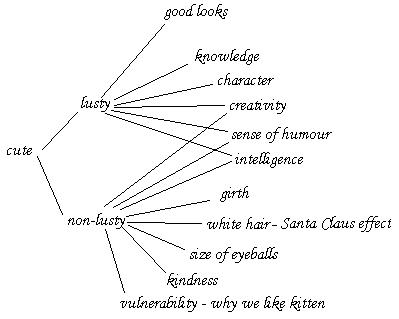
Anyway, once our PaEV idea document was scribed and owls despatched to our pre-occupied team-members for comments, Dee & I had a lengthy discussion on cuteness. I had posted eons ago that I had one theory on what made something cute. I never got down to blogging my theory, though. But Dee & I were able to elaborately define the broad area of what would and would not be considered cute. Actually, it was Dee telling me her views, and I was trying to impress her with my listening skills. By the way, my listening skills are legendary; I have a diagram from yesterday’s conversation to prove it.

It transpires that the factors that lead to cuteness can be of two kinds (I had suspected this all along) - the lusty and the non-lusty. Yeah, some of these factors can fall into either category (the diagram below makes that evident). And you could also have situations where people negate an aspect of their cuteness with some other part of their character. And, there could be cases where a person is cute due to multiple reasons, one of them being lusty and the other, non-lusty.

Anyway, being an Engineer, I shall resort to this fabulous diagram (I can hear the applauses, thank you) to make things clear. Oh, and the "size of eyeballs" factor is what my original theory was. That's what helps Nickey to be perceived as cute and Mr Tinkles as ugly.


"All right, smart engineer," I hear you say, "so what's the point of all this?" Well, here's the meat of this post. If you're a guy and are trying to hit on a girl, you should position yourself in the lusty-cute type. People with casts on their legs fall into the non-lusty cute category. Seriously, breaking a bone or tearing a ligament while playing basketball won't get you anywhere on the lusty-cute-index4. Even if you are wearing a cast and getting a lot of attention, it's the wrong kind of attention. It's the kind of attention that kitten get because they're small and vulnerable. There's no difference between you and the li'l bird that a lady on her morning walk picks up from the street, says "oh, cho chad" and puts it back in its nest. Apparently, this is a reinforcement of Darwinian theories here… I won't bore you with that (even though Biology was one of my favourite subjects till XII5); instead, you can check out this article on NY Times.

Right, so that was what I've learned about cuteness in the last 24 hours. Shall update this space if my views alter significantly.


Notes:
  1. PaEV = Planning an Entrepreneurial Venture - a course that we have.
  2. No, I made that up. ISB's professors are more polished than I've described.
  3. Dee - I've made some modifications to this diagram from yesterday. Hope you don't mind.
  4. The author is in a state of vexation due to the newly-found realisation of his cast's dismal value.
  5. Primarily due to the opportunity to dissect rats.

Monday, 13 March 2006

Wherever you go, pug-rank follows

Here's a blog-entry from Nickey on the official Google blog.

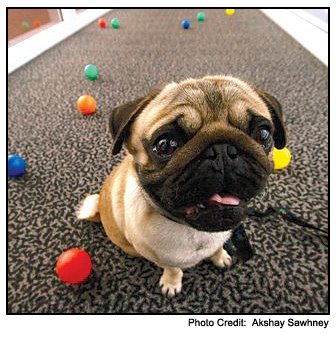
A good number of folks, especially women, would qualify Nickey with adjectives such as "cho-chweet". Guys would too, but they'd acknowledge it only to their girlfriends or significant others... anyway, that's not the main reason why I'm posting.

My question is, why would Nickey elicit a "cho-chweet" response, while the the maniacal Mr Tinkles of the Cats and Dogs fame come quite low on the cuteness index? After all, Mr Tinkles looks more well-groomed than Nickey does. So, what makes people rate an animal (or any other character) as cute, or otherwise?

My theory comes in one of my next posts, hopefully in a few days' time.

Sunday, 22 January 2006

Religion vs Ethics

What does religion give us? Faith
Faith in what? An unknown force/a known force/a recognisable force
What else does religion give you? A moral sense of direction

Hold on! Let's go back on the last one. Do non-believers not have any moral sense of direction? I don't think so. I've known athiests who would gel very well with society and be up to all the socially acceptable norms. Their definition of "right vs wrong" could very well be derived from religion, but it isn't. In fact, one wouldn't come to know that they're atheists unless they said so themselves.

Check out the article Ethics Without Gods, especially the section titled Back to Ethics. The section quotes Plato's argument about there being a standard of "goodness" that is independent of the God who's preaching it.

Thursday, 10 November 2005

Missed Call

Here's a post I'd sent to our class mailing list a few days back....

"Chiranth, give me a missed call." Sure, no problem.
But please tell me what a missed call means, will
you? As far as I know, I can only give you a call.
It's up to you to miss it, intentionally or not. I
cannot create any special magic or dial any special
buttons on my cell phone to transform a regular call
to a missed call. It is you, the receiver who
decides which calls to miss -- am I right?

In the days of the good old land lines, we used to
term these as "blank calls". Yeah, it's true that if
I call up a number and disconnect, it shows up as a
missed call on a mobile -- but that still doesn't
count as a "missed call". It was a matter of chance
that the receiver did not receive the call before I
disconnected, wasn't it?

So please, do me a favour, and if you want to store
my number in your mobile, just ask that I dictate it.
Please don't ask me to give anyone a "missed call".

I've griped enough, I'll shut up now.

Chiranth

Saturday, 5 November 2005

Recruitments & work-experience

I've been trying to think over how companies plan and manage recruitment. Comments welcome.

Companies seem to be planning their growth targets in terms of headcount. It's not rare to come across headlines in newspapers like "xyz to be 10,000 strong in India by Dec 2005." Well, having a measurable growth target of this kind is fine, really. And to measure attrition, they release another headcount -- again, in terms of numbers or percentages.

Though companies measures their personnel growth & attrition through the number of people who join or leave the company, they don't usually publish the number of person-years of experience that has been added or reduced in any given year.

Think about it this way -- let's say I run a startup with 10 people who've got about three years' experience on an average, my staff therefore has a net experience of 30 person-years. If all of these people continue to work with me for another year, the average experience of my staff increases to four years. Even if a person leaves my company, my staff's cumulative experience is still 6 years more than what it was last year, inspite of a 10% attrition.

Let's look at the other aspect. Let's say I start recruiting, and I add in another 10 people to this startup -- 10 college grads with zero experience. Yes, I've doubled my company's headcount, but have I added anything to my net experience? No. Have I added to the company's maturity? If there is a direct correlation between experience and maturity, the answer's again "No". So, what have I added? I've ensured that as these people learn in my company, I am assured of a higher net experience one year down the line! With my staff of nine, I would have had at the end of next year a total experience of 45 years. With these additional ten recruits, I've upped that to 55 years. On the other hand, if any one of my recruits was a person who'd already been in the industry for 10 years, my net experience would jump up by another ten years.

Perhaps, companies' HR teams do actually relate these two factors -- total experience and headcount and build a profile of the average experience of company's personnel. If the average experience of a company shows a gradual increase over time, it probably indicates a) steady growth, and/or b) low attrition. Sharp changes in this average-experience figure would indicate that a company's going through a) an exodus of employees or b) inorganic growth (or disintegration) of some kind. Of course, the greater a company's headcount, the easier it can absorb these shocks of changes in average-experience.